


Applied Physics
Department of Applied Physics
Faculty of Science
Established in 1971, the Department of Applied Physics is one of the pioneering institutions of applied physics education and research in Pakistan, contributing to the country's scientific, technological and industrial landscape.

Solid-State & Semiconductor Physics
Foundational and applied coursework in device physics and electronics.
Instrumentation & DSP
Industrial automation, microwave/RF systems and digital signal processing.
Renewable Energy
Solar, wind and other sustainable-technology research areas.
The department has continuously contributed to specialized fields including Solid-State and Semiconductor Physics, Industrial Automation, Advanced Instrumentation, Microwave and RF Communication Systems, Digital Signal Processing, Microcontroller and Microprocessor-Based Systems, Fibre Optic Communications, Renewable Energy Technologies, and Modern and Quantum Physics — alongside programming proficiency in C, C++, Object-Oriented Programming and Assembly Language.
VisionA National Leader in Applied Physics
The department aims to be recognized as a national leader in applied physics education and research, driving cutting-edge research to address local and global challenges and fostering interdisciplinary innovation in renewable energy, communication systems, nanotechnology, instrumentation and automation.
CareersCareer Opportunities
Graduates find roles across Pakistan's industrial, telecommunications, electronics, energy and scientific research sectors, as well as in government research labs, defense organizations and private technology firms as system analysts, developers and innovators.

Introduction
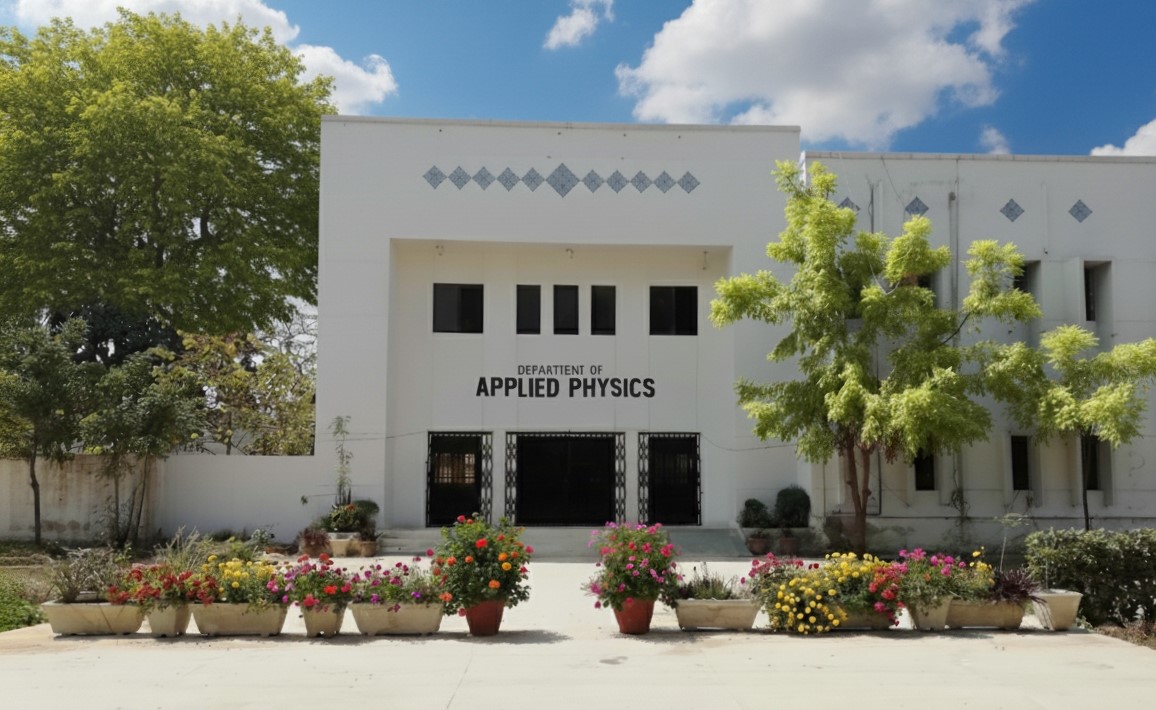
Chairman: Dr. Zeeshan Alam Nayyer (In charge)The Department of Applied Physics at the University of Karachi, established in 1971, stands as one of the pioneering institutions of applied physics education and research in Pakistan. As one of the earliest programs of its kind in the country, it has played a crucial role in advancing the scientific, technological, and industrial landscape of the nation. |
 |
 |
Since its inception, the department has continuously contributed to the development of specialized fields such as Solid-State and Semiconductor Physics, Industrial Automation, Advanced Instrumentation, Microwave and RF Communication Systems, Digital Signal Processing (DSP), Microcontroller and Microprocessor-Based Systems, Fiber Optic Communications, Renewable Energy Technologies, Modern and Quantum Physics, along with programming proficiency in C, C++, Object-Oriented Programming, and Assembly Language. This integrated curriculum blends fundamental science with hands-on technology, ensuring graduates are well-prepared to meet the growing demands of modern industries.
The importance of these subjects is far-reaching across multiple sectors of Pakistan:
- Industrial and Manufacturing Sector: Expertise in automation, microcontroller/microprocessor systems, and advanced instrumentation supports Pakistan’s industrial modernization, enabling industries to improve efficiency, productivity, and competitiveness.
- Telecommunication and IT Sector: Training in microwave/RF systems, DSP, and fiber optic communication equips graduates to serve in the country’s rapidly expanding telecommunication, satellite communication, and internet infrastructure industries.
- Electronics and Semiconductor Industry: Knowledge in semiconductor physics and device fabrication builds capacity for indigenous development of electronic components, reducing dependency on imports.
- Energy Sector: Courses in renewable energy and solid-state physics prepare students to address Pakistan’s critical energy challenges by innovating in solar, wind, and other sustainable technologies.
- Scientific Research and Higher Education: The strong foundation in modern and quantum physics fosters research that not only contributes to global scientific progress but also enriches Pakistan’s higher education and R&D institutions.
- Public and Private Organizations: Programming skills and applied problem-solving prepare graduates to work in government research labs, defense organizations, and private technology firms as system analysts, developers, and innovators.
Through its BS program, the department prepares undergraduates with broad technical competence and problem-solving abilities essential for industry and public service. At the MPhil and PhD levels, the department emphasizes thesis-based research to generate indigenous solutions to national challenges, contributing directly to Pakistan’s scientific advancement and socio-economic growth.
 |
Mission Statement
The mission of the Department of Applied Physics, University of Karachi, is to deliver high-quality education in applied physical sciences that can be effectively utilized across multiple domains of science and technology. The department is committed to developing professional, technical, and analytical skills in its students, while nurturing creativity and innovation. It seeks to prepare future scientists, researchers, technology experts, innovators, and educators who will contribute to industry, academia, and society at large.
Vision
The vision of the Department of Applied Physics is to be recognized as a national leader in applied physics education and research, producing graduates who are not only proficient in theory but also capable of applying their knowledge to real-world challenges. By integrating advanced scientific knowledge with practical technological applications, the department aspires to:
- Drive cutting-edge research in applied physics to address local and global challenges.
- Foster interdisciplinary innovation in areas such as renewable energy, communication systems, nanotechnology, instrumentation, and automation.
- Cultivate an environment where students at the BS, MPhil, and PhD levels develop into highly skilled professionals capable of contributing to national development and international scientific progress.
- Serve as a hub for academic excellence, industry collaboration, and societal impact, creating a bridge between fundamental science and practical applications.
Faculty
| |
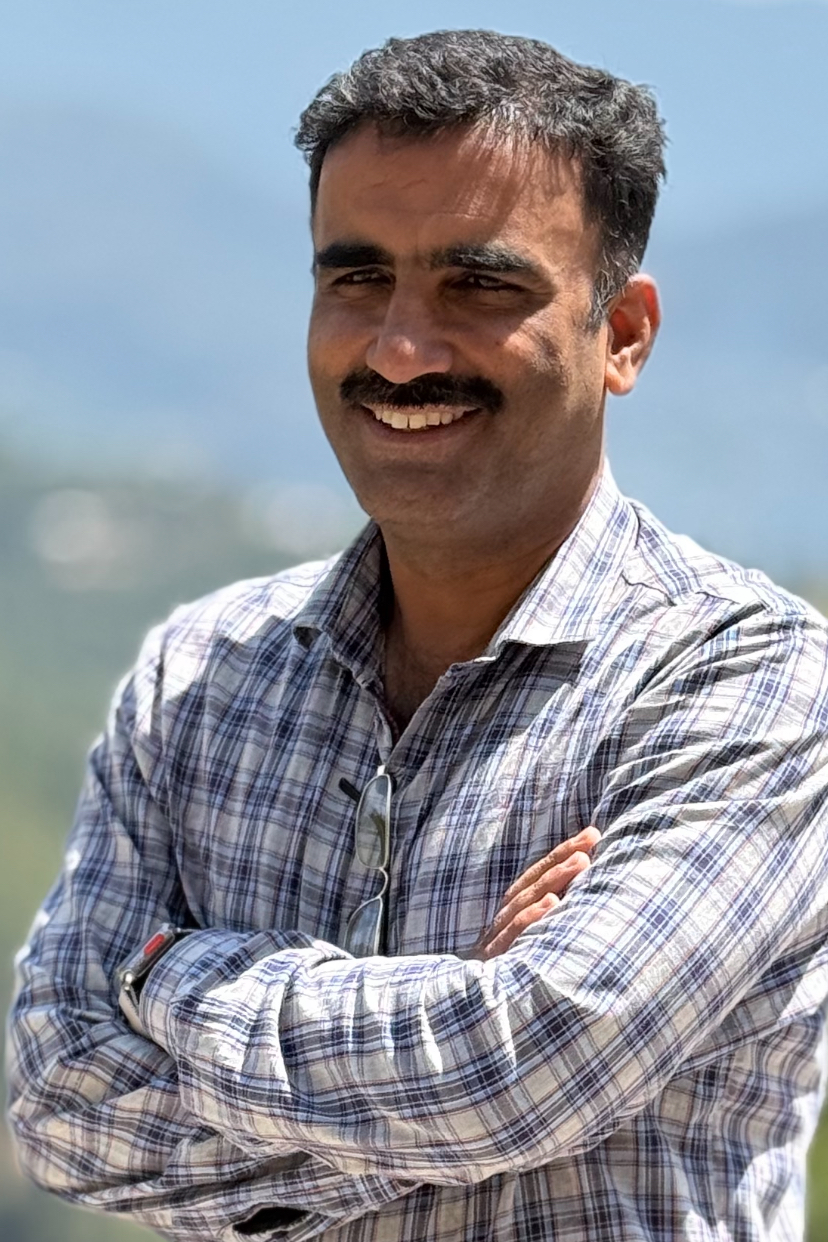
Dr. Zeeshan Alam Nayyar
In-Charge & Assistant Professor |
 |
Dr. Zia Ur Rehman
Assistant Professor |
 |
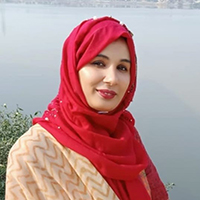
Dr. Faisal Rafique
Assistant Professor (T) |
 |
Dr. Ambreen Insaf
Assistant Professor (T) |
 |
Mr. Syed Mamnoon Akhter
Lecturer |
 |
Ms. Nazia Sadiq
Lecturer |
 |
Mr. Syed Naseer Akhter
Lecturer |
Programs
Degree Programs Offered:
- B.S. Applied Physics
- M.Phil. Applied Physics
- Ph.D. Applied Physics
B.S. Applied Physics
Mission Statement:The mission of the Department of Applied Physics at University of Karachi is to provide profound education in applied physical sciences which can be utilized in various fields of science and technology. The fundamental approach of the department is to develop technical skills in the students and is dedicated to educate future generations of research and development professionals, data specialists, technology experts, innovators, and scientists, for industries, HEIs, R&D organizations and society.Program Objective:
The graduates of the department of Applied Physics, University of Karachi will be able:
- To contribute to advanced technology projects,
- To utilize the technical skills with analytical approach to conduct research.
- To pursue career in R&D organization as JSO/SO/PSO; in various industries as technical officers/HoD instrumentation & control; in system designing and maintenance industry as system analyst, DM/Managers/GM; and in HEIs as Lecturer/Assistant Professor/Associate Professor/Professor.
| Degree Title:: | B.S. Applied Physics |
| Total Credit Hours: | 143 Credit Hours (CH) (General Education: 30 CH; Interdisciplinary: 24 CH; Compulsory: 8 CH; Major 81 CH) |
| Degree Qualifying CGPA: | 2.2 / 4.0 |
| Passing Percentage: | 50% |
| Duration: | 4 Years |
| Semesters: | 8 |
Year I: Semester – I
| S. # | Course Title | Course No. | Credit Hours | Course Type |
| 1. | Urdu or Sindhi or Humanities | 300.1 (U) | 2 + 0 | General Education |
| 2. | Islamic Studies or Ethics (For Non-Muslim) | 300.1 (IS) | 2 + 0 | General Education |
| 3. | Civics and Community Engagement | 300.1(Civ/Com) | 2 + 0 | General Education |
| 4. | Natural Science | 300.1 (N.Sc) | 3 + 0 | General Education |
| 5. | Mathematics I | 301 | 3 + 0 | Interdisciplinary |
| 6. | Introduction to Computer & Programming Languages | Appl. Phys. 303 | 2 + 1 | Interdisciplinary |
| 7. | Mechanics | Appl. Phys. 305 | 2 + 1 | Major |
| 18 Credit Hours | ||||
Year I: Semester – II
| S. # | Course Title | Course No. | Credit Hours | Course Type |
| 1. | Ideology & Constitution of Pakistan | 300.2 (IC) | 2 + 0 | General Education |
| 2. | Pakistan Studies | 300.2 (PSt.) | 2 + 0 | Compulsory |
| 3. | Entrepreneurship | 300.2 (Entr) | 2 + 0 | General Education |
| 4. | Functional English | 300.2 (Eng) | 3 + 0 | General Education |
| 5. | Introduction to Social Science | 300.2 (Soc.Sc) | 2 + 0 | General Education |
| 6. | Mathematics II | 302 | 3 + 0 | Interdisciplinary |
| 7. | Data Structure & Algorithm | Appl. Phys. 304 | 2 + 1 | Interdisciplinary |
| 8. | Electricity & Magnetism | Appl. Phys. 306 | 2 + 1 | Major |
| 20 Credit Hours | ||||
Year II: Semester – III
| S. # | Course Title | Course No. | Credit Hours | Course Type |
| 1. | Quantitative Reasoning I | 400.1 (Q. Reas) | 3 + 0 | General Education |
| 2. | Expository Writing | 400.1 (E. Writ) | 3 + 0 | General Education |
| 3. | Mathematics III | 401 | 3 + 0 | Interdisciplinary |
| 4. | Computational Methods | Appl. Phys. 403 | 2 + 1 | Interdisciplinary |
| 5. | Circuit Theory | Appl. Phys. 405 | 2 + 1 | Major |
| 6. | Quantum Mechanics | Appl. Phys. 407 | 3 + 0 | Major |
| 18 Credit Hours | ||||
Year II: Semester – IV
| S. # | Course Title | Course No. | Credit Hours | Course Type |
| 1. | Quantitative Reasoning II | 400.2 (Q. Reas) | 3 + 0 | General Education |
| 2. | Application of Information & Communication Technologies | 400.2 (ICT) | 3 + 0 | General Education |
| 3. | Mathematics IV | 402 | 3 + 0 | Interdisciplinary |
| 4. | Introduction to Computer Networks | Appl. Phys. 404 | 2 + 1 | Interdisciplinary |
| 5. | Basic Electronic | Appl. Phys. 406 | 2 + 1 | Major |
| 6. | Introduction to Renewable Energy | Appl. Phys. 408 | 3 + 0 | Major |
| 18 Credit Hours | ||||
Year III: Semester – V
| S. # | Course Title | Course No. | Credit Hours | Course Type |
| 1. | Linear Integrated Circuits | Appl. Phys. 501 | 3 + 0 | Major |
| 2. | Laser and Applied Optics | Appl. Phys. 503 | 3 + 0 | Major |
| 3. | Power Electronics | Appl. Phys. 505 | 3 + 0 | Major |
| 4. | Solid State Physics | Appl. Phys. 507 | 3 + 0 | Major |
| 5. | Digital Electronics | Appl. Phys. 509 | 2 + 1 | Major |
| 6. | Experimental Electronics I | Appl. Phys. 511 | 0 + 3 | Major |
| 18 Credit Hours | ||||
Year III: Semester – VI
| S. # | Course Title | Course No. | Credit Hours | Course Type |
| 1. | Communication Electronics | Appl. Phys. 502 | 3 + 0 | Major |
| 2. | Semiconductor Devices | Appl. Phys. 504 | 3 + 0 | Major |
| 3. | Digital Logic Design | Appl. Phys. 506 | 1 + 2 | Major |
| 4. | Industrial Electronics & Automation | Appl. Phys. 508 | 3 + 0 | Major |
| 5. | Signal and Systems | Appl. Phys. 510 | 3 + 0 | Major |
| 6. | Experimental Electronics II | Appl. Phys. 512 | 0 + 3 | Major |
| 18 Credit Hours | ||||
Year IV: Semester – VII
| S. # | Course Title | Course No. | Credit Hours | Course Type |
| 1. | Microprocessor Architecture & Programming | Appl. Phys. 601 | 2 + 1 | Major |
| 2. | Microwave Communication | Appl. Phys. 603 | 2 + 1 | Major |
| 3. | Elective I | Appl. Phys. 61x | 3 + 0 | Major |
| 4. | Elective II / Thesis I | Appl. Phys. 62x | 3 + 0 | Major |
| 5. | Internship | 600.1 | 0 + 3 | Compulsory |
| 15 Credit Hours | ||||
Year IV: Semester –VIII
| S. # | Course Title | Course No. | Credit Hours | Course Type |
| 1. | Digital Signal Processing | Appl. Phys. 602 | 2 + 1 | Major |
| 2. | Microprocessor Interfacing | Appl. Phys. 604 | 1 + 2 | Major |
| 3. | Control Systems | Appl. Phys. 606 | 3 + 0 | Major |
| 4. | Elective III | Appl. Phys. 61x | 3 + 0 | Major |
| 5. | Elective IV / Thesis II | Appl. Phys. 62x | 3 + 0 | Major |
| 6. | Capstone Project | 600.2 | 0 + 3 | Compulsory |
| 18 Credit Hours | ||||
Elective Courses
| S. # | Course Title | Course No. | Credit Hours | Course Type |
| 1. | Introduction to Nanotechnology | Appl. Phys. 611 | 3 + 0 | Elective-I |
| 2. | Embedded System | Appl. Phys. 613 | 2 + 1 | Elective-I |
| 3. | Data Communication & Networking | Appl. Phys. 615 | 3 + 0 | Elective-I |
| 4. | Wind and Solar Energy | Appl. Phys. 617 | 3 + 0 | Elective-I |
| 5. | Nanoelectronic Devices | Appl. Phys. 621 | 3 + 0 | Elective-II |
| 6. | Internet-of-Things (IoT) | Appl. Phys. 623 | 2 + 1 | Elective-II |
| 7. | Broadband Communication | Appl. Phys. 625 | 3 + 0 | Elective-II |
| 8. | Biofuels and Biomass Energy | Appl. Phys. 627 | 3 + 0 | Elective-II |
| 9. | Thesis I | Appl. Phys. 629 | 0 + 3 | Elective-II |
| 10. | Electronic Transport at Nanoscale | Appl. Phys. 612 | 3 + 0 | Elective-III |
| 11. | Instrumentation | Appl. Phys. 614 | 3 + 0 | Elective-III |
| 12. | Optical Communication | Appl. Phys. 616 | 2 + 1 | Elective-III |
| 13. | Tidal and Hydro Energy | Appl. Phys. 618 | 3 + 0 | Elective-III |
| 14. | Functional Materials | Appl. Phys. 620 | 3 + 0 | Elective-IV |
| 15. | Artificial Intelligence & Machine Learning | Appl. Phys. 622 | 3 + 0 | Elective-IV |
| 16. | Wireless Communications | Appl. Phys. 624 | 3 + 0 | Elective-IV |
| 17. | Smart Grid Technology | Appl. Phys. 626 | 3 + 0 | Elective-IV |
| 18. | Thesis II | Appl. Phys. 628 | 0 + 3 | Elective-IV |
M.Phil. Applied Physics
Mission Statement:The program mission of post-graduate studies at the Department of Applied Physics is to provide research based education and learnings in the various field of applied physical sciences through rigorous research work. The program’s primary mission is to equip MPhil scholars with advanced research skills, including literature review, data collection and analysis, experimental design, and critical thinking. By the end of the program, students should be proficient in conducting independent and rigorous research in their respective fields. Program Objective:
- The program aims to cultivate intellectual independence among MPhil students. This involves encouraging students to explore their research interests, develop their own research questions, and pursue innovative approaches to problem-solving. By fostering intellectual independence, the program seeks to produce scholars who can make original contributions to knowledge.
- A key objective of the MPhil program is to deepen students' subject matter expertise. Through rigorous coursework, seminars, and engagement with leading scholars in the field, students will develop a comprehensive understanding of the theoretical frameworks, methodologies, and key debates relevant to their research area. This objective ensures that students become authorities in their chosen fields.
- The program emphasizes the development of strong communication skills among MPhil students. This includes both written and oral communication, as students are expected to present and defend their research findings to academic audiences. Additionally, students will be encouraged to disseminate their research through publications and conference presentations, ensuring that their work reaches a wider scholarly community.
- The MPhil program places a strong emphasis on ethical research practices. Students will be guided to adhere to ethical principles and guidelines while conducting their research, including obtaining informed consent, ensuring data privacy and confidentiality, and maintaining integrity in reporting research findings. This objective ensures that students become responsible researchers who contribute to the advancement of knowledge while upholding ethical standards.
| Degree Title:: | M.Phil. Applied Physics |
| Total Credit Hours: | 30 Credit Hours (CH) = (Theory: 24 CH; Thesis: 06 CH) |
| Duration: | 2 - 4 Years |
M.Phil. Applied Physics (Telecommunications)
Year I: Semester – I
| S. # | Course Title | Course No. | Credit Hours |
| 1. | Research Methodology I | Appl. Phys.700.1 | 3 + 0 |
| 2. | Stochastic Processes | Appl. Phys.701 | 3 + 0 |
| 3. | Optical Networks | Appl. Phys.703 | 3 + 0 |
| 4. | Wireless and Cellular Communications | Appl. Phys.705 | 3 + 0 |
Year I: Semester – II
| S. # | Course Title | Course No. | Credit Hours |
| 1. | Research Methodology II | Appl. Phys.700.2 | 3 + 0 |
| 2. | Information Theory and Coding | Appl. Phys.702 | 3 + 0 |
| 3. | Advanced Digital Communications | Appl. Phys.704 | 3 + 0 |
| 4. | Broadband Communication Systems | Appl. Phys.706 | 3 + 0 |
M.Phil. Applied Physics (Semiconductor Technology)
Year I: Semester – I
| S. # | Course Title | Course No. | Credit Hours |
| 1. | Research Methodology I | Appl. Phys.700.1 | 3 + 0 |
| 2. | Advanced Solid State Physics | Appl. Phys.707 | 3 + 0 |
| 3. | Vacuum Technology | Appl. Phys.709 | 3 + 0 |
| 4. | Electronic Properties of Submicron Solid State Devices | Appl. Phys.711 | 3 + 0 |
Year I: Semester – II
| S. # | Course Title | Course No. | Credit Hours |
| 1. | Research Methodology II | Appl. Phys.700.2 | 3 + 0 |
| 2. | Dielectric Relaxation in Solids | Appl. Phys.708 | 3 + 0 |
| 3. | Photonic Properties of Solids | Appl. Phys.710 | 3 + 0 |
| 4. | L.I.C. & Communications | Appl. Phys.712 | 3 + 0 |
M.Phil. Applied Physics (Applied Atmospheric Physics)
Year I: Semester – I
| S. # | Course Title | Course No. | Credit Hours |
| 1. | Research Methodology I | Appl. Phys.700.1 | 3 + 0 |
| 2. | Ionospheric Physics | Appl. Phys.713 | 3 + 0 |
| 3. | Remote Sensing and Image interpretation | Appl. Phys.715 | 3 + 0 |
| 4. | Applied Space Plasma Physics | Appl. Phys.717 | 3 + 0 |
Year I: Semester – II
| S. # | Course Title | Course No. | Credit Hours |
| 1. | Research Methodology II | Appl. Phys.700.2 | 3 + 0 |
| 2. | Applied Space Physics | Appl. Phys.714 | 3 + 0 |
| 3. | Applied Environmental Physics | Appl. Phys.716 | 3 + 0 |
| 4. | Applied Astrophysics | Appl. Phys.718 | 3 + 0 |
Ph.D. Applied Physics
Mission Statement:The mission of the PhD program at the Department of Applied Physics is to advance the frontiers of knowledge through original, high-impact research in the applied physical sciences. The program is committed to fostering research excellence by equipping doctoral scholars with the expertise, innovation capacity, and critical thinking skills necessary to address complex scientific challenges. Through a rigorous and immersive research experience, the program aims to produce thought leaders capable of conducting independent, ethically responsible, and globally relevant research that contributes meaningfully to academia, industry, and society.Program Objective:
- The PhD program is designed to cultivate advanced intellectual independence and research leadership. Doctoral candidates are expected to formulate and execute original research agendas, addressing complex problems through innovative methodologies. The program aims to produce scholars capable of independently advancing the frontiers of knowledge and leading interdisciplinary research efforts.
- A central objective of the PhD program is to enable students to attain deep and specialized expertise in their chosen field, while also contributing to the development of new theories, models, or frameworks. Through intensive research, critical inquiry, and scholarly discourse, PhD students are expected to become thought leaders and innovators in their academic domains.
- The program emphasizes the development of sophisticated communication skills that allow PhD scholars to effectively engage with international academic and professional communities. Students will produce high-impact publications, present at prestigious conferences, and communicate complex ideas clearly and persuasively to both academic and non-academic audiences.
- The PhD program is committed to cultivating a culture of ethical leadership in research. Students will adhere to the highest standards of academic integrity, ethical conduct, and social responsibility. They will be trained to address ethical dilemmas in advanced research and to contribute to policy-making, education, and knowledge dissemination while upholding ethical standards.
| Degree Title:: | Ph.D. Applied Physics |
| Total Credit Hours: | 18 Credit Hours Theory + PhD Dissertation |
| Duration: | 3 - 8 Years |
Year I: Semester – I
| S. # | Course Title | Course No. | Credit Hours |
| 1. | Research Seminars | Appl. Phys.801 | 0 + 4 |
| 2. | Thesis and Manuscript Writing Skills | Appl. Phys.803 | 0 + 4 |
Year I: Semester – II
| S. # | Course Title | Course No. | Credit Hours |
| 1. | Seminar on Current Advancements in Applied Physics | Appl. Phys.802 | 0 + 4 |
| 2. | Development of Research Proposal for Funding Agencies | Appl. Phys.804 | 0 + 6 |
Research
Research
The Department of Applied Physics integrates fundamental science with applied research to address critical challenges in energy, materials, optics, and other allied fields. Faculty members are engaged in multidisciplinary projects that advance knowledge, foster innovation, and contribute directly to Pakistan’s technological and industrial development.
Research in renewable energy through Renewable Energy research Lab (RERL) focuses on technologies that support Pakistan’s transition toward sustainability. Key areas include, but not limited to, wind energy resource assessment, GIS-based energy modeling, tidal energy, waste-to-energy, smart grid systems.
Faculty members are actively engaged in advanced materials research in Nanoscale Synthesis & Research Laboratory (NSRL), emphasizing next-generation applications like 2D materials, topological materials, composite materials and thin films.
Research in optics and related systems supports technological advancement in communication, sensing, and energy applications for electro-optical & electro-mechanical systems and thermal optics.
Through these research domains, the Department of Applied Physics contributes to advancing scientific knowledge, developing indigenous technologies, and training skilled professionals capable of addressing Pakistan’s industrial, academic, and societal needs.
Research Labs
1. Renewable Energy Research Lab (RERL):
The Renewable Energy Research Lab (RERL), formerly known as the Renewable Energy Research Group, was founded in 2012. From the very beginning, RERL has been committed to addressing the pressing global challenges of climate change, energy security, and environmental sustainability.
Our lab is a hub for innovation, focusing on research areas like wind, solar, tidal, waste-to-energy and smart grids. We're not just about theory—we're on a mission to develop practical, cost-effective solutions that benefit the planet and make renewable energy accessible to all.
At RERL, we provide an inspiring space for undergraduate and postgraduate students to explore and solve real-world energy problems. Whether they're working with cutting-edge software or experimenting with advanced hardware, students are deeply involved in shaping the future of energy.
Finally, RERL is backed with high impacts research publications in prestigious journals and conference participations covering different aspects of wind, solar, smart grid, and related energy resources.
2. Nanoscale Synthesis & Research Laboratory (NSRL):
This lab consists of two sub sections:
- KM Aleem Nanotech Laboratory
- Ansari & Zaidi Thin Film Laboratory
This laboratory is named after KM Aleem (late), one of the alumni of this department. It was established with the generous funding and efforts of the family and friends (Alumni 1982) of late KM Aleem. This section caters the synthesis of nano materials in general and 2D materials in particular. Synthesis of 2D materials is done using Chemical Vapor Technique (CVT), Chemical Vapor Deposition (CVD) as well as hydrothermal method. Moreover, facility is also available to synthesize nanomaterials using wet chemical method. Synthesized materials can be used in electronics, optoelectronics, sensors, energy applications etc.
We are actively working on the synthesis of TMDs, Mxenes, and other 2D materials in this laboratory.
This lab is named after two of pioneer professors of this department to pay homage for their services to the department. This lab aims at growth of thin films for electronic, optoelectronics, sensor, and photovoltaic applications. Thin film growth is carried out by thermal evaporation method using a vacuum coating unit. The lab is equipped with the facilities to study electrical transport and dielectric properties of thin films. Moreover, we also use spin coater and ultrasonic bath for the fabrication of thin films. We are planning to use these facilities to synthesis composite materials as well.
These labs are supported by extensive publication track record in basic physics, applied physics and material physics journals of high repute.
List of Publications:
1 |
Faisal Ghazanfar, Zeeshan A. Nayyar, Abid Karim, Muhammad Saeed, Arif Karim, Mujahid Hussain. 2025. The Industrial Transitions and their Impact on Wind Solar Hybrid Power Generation with Inference Model Approach. Pakistan Journal of Scientific and Industrial Research Series A: Physical Sciences. DOP: March 10, 2025. Vol. 68 (1). 71-78. HEC Category ‘Y’ Journal. |
2 |
Zia ur Rehman, Zahir Muhammad, et al."Electronic structure investigation and anisotropic phonon anharmonicity in ternary ZrGeTe4 single crystals." Applied Physics Letters 125.14 (2024). Impact Factor: 4.0 |
3 |
Zahir Muhammad, Zia ur Rehman, et. al. “Signature of phonon anharmonicity in highly in-plane anisotropic ternary HfGeTe4 single crystals”, Appl. Phys. Lett. (2024), Doi: 10.1063/5.0191461, Impact Factor: 4.0 |
4 |
Mirza S. Baig, Ambreen Insaf, Saba Javaid, Zaheer Uddin. 2024. Geostatistical Model Development and Assessment of Tidal Stream Energy Resources: A Case Study of Indus Delta, Pakistan. Proceedings of the Pakistan Academy of Sciences: A. Physical and Computational Sciences. Vol. 61(4). 381-390. |
5 |
Shafiq U. Rehman, Atteeq Razzak, Ambreen Insaf, Ahmed A. Rajput, Tahreem Khan, Tehreem Rashid. 2024. New method to model the wind speed distribution: method of decile. Canadian Journal of Physics. Vol. 103(4). 377-388. |
6 |
Nayyer A. Zaigham, Omar S. Aburizaiza, Zeeshan A. Nayyar, Gohar A. Mahar. Volcanic Terrains Reveal Bright Hydrogeological Prospects in Saudi Arabia: A GIS & RSA Linked Research on Harrat Rahat. In Satellite Monitoring of Water Resources in the Middle East, Shaban A. (ed). 2022. ISBN: 978-3-031-15548-2. eISBN: 978-3-031-15549-9. Springer Cham. Switzerland. 287-310. DOI: 10.1007/978-3-031-15549-9. (Book Chapter) |
7 |
Nayyer A. Zaigham, Omar S. Aburizaiza, Zeeshan A. Nayyar, Gohar A. Mahar, M. Abbas. 2022. Neo-Hydro-Tectonic Assessment of As-Sabaya Island Emerged in Southern Saudi Arabian Red Sea Offshore Region. International Journal of Water Resources and Arid Environments. DOP: January 2022. Vol. 11 (1). 27-42. ISSN: 2079-7079. UoK BASR Recognize Journal. |
8 |
Sheng Wang, Zia ur Rehman, Zhenfeng Liu, Li Song, Zhe Sun. “Tailoring of bandgap and spin-orbit in ZrSe2 with low substitution of Ti for Zr”, Chinese Physics Letters (2022), DOI: 10.1088/0256-307X/39/7/077102. Impact Factor: 2.3 |
9 |
Hannan, Abdul, Adnan Khalil, Muhammad Habib, Zia ur Rehman, Abdul Ghafar Wattoo, Muhammad Yousaf, Hamza Naeem, Imen Kebaili, Hussein Alrobei, and Meshal Alzaid."Ferromagnetic Properties of Ni9S8/MoS2 Hybrid Structure." Journal of Superconductivity and Novel Magnetism (2022): 1-7. Impact Factor: 1.87 |
10 |
Nayyer A. Zaigham, Gohar A. Mahar, Omar S. Aburizaiza, Zeeshan A. Nayyar. 2022. Strategic management of flood water can ensure food security in desertic east‑region of Medina, Saudi Arabia. Arabian Journal of Geosciences. DOP: July 06, 2022. Vol. 15. 1258. DOI: 10.1007/s12517-022-10553-0. Impact Factor:1.827. |
11 |
Ambreen Insaf, Mirza S. Baig, Saba Javaid, Umair Abbas, Zaheer Uddin. 2022. Tidal Range Energy Resource Estimation of Khor Kalmat using Geostatistical Modeling. Proceedings of the Pakistan Academy of Sciences: A. Physical and Computational Sciences. Vol. 59(4). 45-53. |
12 |
Ambreen Insaf, Mirza S. Baig, Zaheer Uddin. 2022. Tidal range energy resource assessment and power generation at Hawke’s Bay and Ghizri. Arabian Journal of Geosciences. Vol. 15(10). 960. |
13 |
Ahmed Ali, Zeeshan A. Nayyar. 2021. A Modified Built-up Index (MBI) for Automatic Urban Area Extraction from Landsat 8 Imagery. Infrared Physics and Technology. DOP: August 2021. Vol. 116. 103769. DOI: 10.1016/j.infrared.2021.103769. Impact Factor: 2.997. |
14 |
Nayyer A. Zaigham, Gohar A. Mahar, Omar S. Aburizaiza, Zeeshan A. Nayyar. 2021. Historical flood imprints reveal factors causing catastrophic impacts on modern Jeddah, Saudi Arabia: a case of flash floods versus rapid urbanization. Arabian Journal of Geosciences. DOP: February 19, 2021. Vol. 14. 342. DOI: 10.1007/s12517-021-06703-5. Impact Factor:1.827. |
15 |
Nayyer A. Zaigham, Tanveer Alam, Gohar A. Mahar, Zeeshan A. Nayyar. 2021. Dust storms Add in Blooming of Phytoplankton, Tiny Wanderer Plants as Food-Chain, Over Arabian Sea: A Research Study based on Temporal Satellite Images. Pakistan Journal of Botany. Vol. 53(4). DOI: 10.30848/PJB2021-4(8). Impact Factor: 1.101. |
16 |
Mirza S. Baig, Zaheer Uddin, Ambreen Insaf. 2021. GIS-linked tidal range energy resource assessment. Arabian Journal of Geosciences, Vol. 14(6). 491. |
17 |
Mirza S. Baig, Zaheer Uddin, Ambreen Insaf. 2021. The Parametric Estimation of Tidal Potential Power Density using Modeling Strategies at Hajambro Creek of Indus Delta, Pakistan: Development of Tidal Potential Power Density Models for Hajambro Creek, Pakistan. Proceedings of the Pakistan Academy of Sciences: A. Physical and Computational Sciences. Vol. 58(2). 19-27. |
18 |
Fozia Zaheer, Saif U. Jilani, Muhammad A.Uddin, Ambreen Insaf, Syed M. Akhtar, Zaheer Uddin. 2021. A new approach to assess wind potential. Global NEST Journal. Vol. 23(4). 532-543. |
19 |
Ahmed Ali, Zeeshan A. Nayyar. 2020. Extraction of Mangrove Forest through Landsat 8 Mangrove Index (L8MI). Arabian Journal of Geosciences. DOP: October 22, 2020. Vol. 13. 1132. DOI: 10.1007/s12517-020-06138-4. Impact Factor:1.827. |
20 |
Nayyer A. Zaigham, Omar S. Aburizaiza, Gohar A. Mahar, Zeeshan A. Nayyar. 2020. Hydrogeologic Assessment for Groundwater Prospects in Al-Abwa Drainage Basin, Arid-Terrain of Arabian Shield, Saudi Arabian Red Sea Coastal-Belt. Arabian Journal of Geosciences. DOP: May 16, 2020. Vol. 13. 270. DOI: 10.1007/s12517-020-05367-x. Impact Factor:1.827. |
21 |
Zeeshan A. Nayyar, Ahmed Ali. 2020. Roughness Classification Utilizing Remote Sensing Techniques for Wind Resource Assessment. Renewable Energy. DOP: April 2020. Vol. 149. 66-79. DOI: 10.1016/j.renene.2019.12.044. Impact Factor: 8.634. |
22 |
Guo, He, Wen Zhu, Zia ur Rehman, ChuanQiang Wu, Shuangming Chen, and Li Song."Ternary MoSe2xTe2-2x Alloy with Tunable Band Gap for Electronic and Optoelectronic Transistors." Nanotechnology (2020). Impact Factor: 3.96 |
23 |
Adam, Mukhtar Lawan, OyawaleAdetunji Moses, Zia ur Rehman, Zhanfeng Liu, Li Song, and Xiaojun Wu."Band gap engineering of monolayer ZrGeTe4 via strain: A first-principles study." Materials Chemistry and Physics (2020): 123308. Impact Factor: 4.78 |
24 |
Ambreen Insaf, Zaheer Uddin, Mirza S. Baig. 2020. An initial assessment of tidal energy resources using GIS for Miani Hor, Baluchistan province, Pakistan. Arabian Journal of Geosciences. Vol. 13(4). 1-15. |
25 |
Zeeshan A. Nayyar, Nayyer A. Zaigham, Nadeem Mahmood, Muhammad Saeed, Ahmed Ali, Nazia Sadiq. 2019. Review of Available Barriers to the Wind Energy Development Activities in the Coastal Areas of Pakistan. Sukkur IBA Journal of Computing and Mathematical Sciences. DOP: September 13, 2019. Vol 3(1). 58-62. DOI: 10.30537/sjcms.v3i1.321. HEC Category ‘Y’ Journal. |
26 |
Ahmed Ali, Zeeshan A. Nayyar. 2019. Utilization of Advanced Slope based Indexing Technique (ASIT) for the extraction of Built-up land. International Journal of Remote Sensing. DOP: February 27, 2019. Vol. 40(15). 5992-6007. DOI: 10.1080/01431161.2019.1585592. Impact Factor: 3.531. |
27 |
Muhammad, Zahir, Bo Zhang, HaifengLv, Huan Shan, Zia Ur Rehman, Shuangming Chen, Zhe Sun, Xiaojun Wu, Aidi Zhao, and Li Song."Transition from Semimetal to Semiconductor in ZrTe2 Induced by Se Substitution." ACS nano 14, no. 1 (2019): 835-841. Impact Factor: 18.03 |
28 |
Chuanqiang Wu, Dongdong Li, Shiqing Ding, Zia ur Rehman, Qin Liu, Shuangming Chen, Bo Zhang, and Li Song."Monoatomic Platinum Anchored Metallic MoS2: Correlation between Surface Dopant and Hydrogen Evolution." The Journal of Physical Chemistry Letters (2019). Impact Factor: 6.89 |
29 |
Zia ur Rehman, Sheng Wang, Mukhtar Adam Lawan, Shah Zareen, Oyawale Adetunji Moses, Wen Zhu, Xiaojun Wu, Zhe Sun, and Li Song “Band structure tailoring in ZrSe2 single crystals via trace Rhenium intercalation” Appl. Phys. Lett. 115, 213102 (2019); doi: 10.1063/1.5115280. Impact Factor: 4.0 |
30 |
Ambreen Insaf, Muhammad A. Uddin, Mushtaq Ahmed, Mirza S. Baig. 2019. Dynamics of Renewable Energy in Pakistan: Tidal Energy as a Future Prospect. European Academic Research. Vol. 6(12). 18. |
31 |
Zia ur Rehman, Wen Zhu, Sheng Wang, YijieNiu, Zahir Muhammad, Oyawale Adetunji Moses, Chuanqiang Wu, Muhammad Habib, Shuangming Chen, Xiaojun Wu, Zhe Sun, Pulickel M. Ajayan, and Li Song."Selective Selenium-Substituted Metallic MoTe2 Towards Ternary Atomic Layers with Tunable Semiconducting Character." The Journal of Physical Chemistry C 123(2019): 24927-24933, DOI:10.1021/acs.jpcc.9b06881. Impact Factor: 4.2 |
32 |
Zia ur Rehman, Muhammad, Zahir, Oyawale Adetunji Moses, Wen Zhu, Chuanqiang Wu, Qun He, Muhammad Habib and Li Song."Magnetic Isotropy/Anisotropy in Layered Metal Phosphorous Trichalcogenide MPS3 (M= Mn, Fe) Single Crystals." Micromachines9.6 (2018): 292. Impact Factor: 3.53 |
33 |
Qun He, HuiXie, Zia ur Rehman, Changda Wang, Ping Wan, Hongliang Jiang, Wangsheng Chu, and Li Song."Highly defective Fe-based oxyhydroxides from electrochemical reconstruction for efficient oxygen evolution catalysis." ACS Energy Letters 3 (2018): 861-868. Impact Factor: 23.99 |
34 |
Oyawale, A. M., Malik Ihsanullah Khan, Qi Feng, Qin Liu, Zia ur Rehman, Youkui Zhang, Cao Deng Feng, Yinchu Ma, XinFeng Tang, Chuanqiang Wu, MukhtarLawan Adam, Dake Huang, Hang Liu and Li Song."PVP intercalated metallic WSe2 as NIR photothermal agents for efficient tumor ablation." Nanotechnology 30 (2018): 065102. Impact Factor: 3.96 |
35 |
Muhammad, Zahir, Faiz Wali, and Zia ur Rehman."Optical filters for linearly polarized light using sculptured nematic thin flim of TiO2." Materials Research Express (2018). Impact Factor: 2.03 |
36 |
Zhu Jiadi, Yuchao Yang, RundongJia, Zhongxin Liang, Wen Zhu, Zia ur Rehman, Lin Bao, Xiaoxian Zhang, YimaoCai, Li Song and Ru Huang."Ion gated synaptic transistors based on 2D van der Waals crystals with tunable diffusive dynamics." Advanced Materials 30 (2018): 1800195. Impact Factor: 32.09 |
37 |
Daobin Liu, Shiqing Ding, Chuanqiang Wu, Wei Gan, Changda Wang, Dengfeng Cao, Zia ur Rehman, Yuan Sang, Shuangming Chen, XushengZheng, Yu Wang, Binghui Ge and Li Song."Synergistic effect of an atomically dual-metal doped catalyst for highly efficient oxygen evolution." Journal of Materials Chemistry A 6(2018): 6840-6846. Impact Factor: 14.51 |
38 |
Daobin Liu, Chuanqiang Wu, Shuangming Chen, Shiqing Ding, YaofengXie, Changda Wang, Tao Wang, Yasir A. Haleem, Zia ur Rehman, Yuan Sang, Qin Liu, Xusheng Zheng, Yu Wang, BinghuiGe, HangxunXu, and Li Song."In situ trapped high-density single metal atoms within graphene: Iron-containing hybrids as representatives for efficient oxygen reduction." Nano Research 11 (2018): 2217-2228. Impact Factor: 10.27 |
39 |
Muhammad Habib, Zahir Muhammad, Rashid Khan, Chuanqiang Wu, Zia ur Rehman, Yu Zhou, Hengjie Liu, and Li Song."Ferromagnetism in CVT grown tungsten diselenide single crystals with nickel doping." Nanotechnology 29 (2018): 115701. Impact Factor: 3.953 |
40 |
Zahir Muhammad, Kejun Mu, HaifengLv, Chuanqiang Wu, Zia ur Rehman, Muhammad Habib, Zhe Sun, Xiaojun Wu, and Li Song."Electron doping induced semiconductor to metal transitions in ZrSe2 layers via copper atomic intercalation." Nano Research 11 (2018): 4914-4922. Impact Factor: 10.27 |
41 |
Zahir Muhammad, HaifengLv, Chuanqiang Wu, Muhammad Habib, Zia ur Rehman, Rashid Khan, Shuangming Chen, Xiaojun Wu, and Li Song."Room temperature ferromagnetism in Fe-doped semiconductor ZrS2 single crystals." Materials Research Express 5 (2018): 046110. Impact Factor: 2.03 |
42 |
Nayyer A. Zaigham, Omar S. Aburizaiza, Gohar A. Mahar, Zeeshan A. Nayyar, Naseer A-Amri. 2017. Satellite Remote Sensing Analyses for Hydrogeological Assessment of Rabigh Drainage Basin, Red Sea Coast, Saudi Arabia. International Journal of Water Resources and Arid Environments. DOP: April 2017. Vol. 6(1). 1-12. ISSN: 2079-7079. UoK BASR Recognize Journal. |
43 |
Muhammad Habib, Adnan Khalil, Zahir Muhammad, Rashid Khan, Changda Wang, Zia ur Rehman, Hafiz Tariq Masood, WeiyuXu, Hengjie Liu, Wei Gan, Chuanqiang Wu, Haiping Chen, and Li Song."WX2 (X= S, Se) Single Crystals: A Highly Stable Material for Supercapacitor Applications." Electrochimica Acta 258 (2017): 71-79. Impact Factor: 7.34 |
44 |
Rashid Khan, Muhammad Habib, Mohammed A Gondal, Adnan Khalil, Zia ur Rehman, Zahir Muhammad, Yasir A. Haleem, Changda Wang, Chuanqiang Wu, and Li Song."Facile synthesis of CuFe2O4–Fe2O3 composite for high-performance supercapacitor electrode applications." Materials Research Express 4 (2017): 105501. Impact Factor: 2.03 |
45 |
Adnan Khalil, Qin Liu, Zahir Muhammad, Muhammad Habib, Rashid Khan, Qun He, Qi Feng, Hafiz Tariq Masood, Zia ur Rehman, Ting Xiang, Chuanqiang Wu, and Li Song."Synthesis of Ni9S8/MoS2 heterocatalyst for enhanced hydrogen evolution reaction." Langmuir 33 (2017): 5148-5153 Impact Factor: 4.33 |
46 |
Xingbo Wang, Weifeng Huang, Shi Tao, HuiXie, Chuanqiang Wu, Zhen Yu, XiaozhiSu, Jiaxin Qi, Zia ur Rehman, Li Song, Guobin Zhang, Wangsheng Chu, ShiqiangWei."Attainable high capacity in Li-excess Li-Ni-Ru-O rock-salt cathode for lithiumion battery." Journal of Power Sources 359 (2017): 270-276. Impact Factor: 9.8 |
47 |
Mirza S. Baig, Zaheer Uddin, Ambreen Insaf. 2017. An initial tidal power resource estimation at jhari creek of Indus Delta, Sindh, Pakistan. Journal of Basic & Applied Sciences. Vol. 13. 545-550. |
48 |
Haiping Chen, Zehao Ma, Yanjie Shao, Zia ur Rehman, Ke Zhang, Qun He and Li Song."Angle-/temperature-dependence of Raman scattering in layered NbSe3 crystal." AIP Advances7 (2017): 095316. Impact Factor: 1.7. |
49 |
Zia ur Rehman, Wen Zhu, Peng Wu, and Li Song “Solid State Synthesis of Two-dimensional Layered Crystals”, Inorganic Two-dimensional Nanomaterials, (Royal Society of Chemistry 2017), ISBN: 978-1-78262-465-3. (Book Chapter) |
50 |
Ambreen Insaf, Mirza S. Baig, Anila Kausar, Taufeeque Rauf, Muhammad Shahzad, Salman A. Khan, Zaheer Uddin. 2016. Estimation of various tidal parameters and possibility for harnessing tidal energy along the southeast coastal area of Karachi, Pakistan. Science International, Vol. 28(1). |
51 |
Nayyer A. Zaigham, Omar S. Aburizaiza, Gohar A. Mahar, Zeeshan A. Nayyar, Azhar Siddique. 2015. Watershed analysis of Rabigh drainage basin, Saudi Arabia. International Journal of Water Resources and Arid Environments. DOP: October 2015. Vol. 4(2). 138-145. ISSN: 2079-7079. UoK BASR Recognize Journal. |
52 |
Zia ur Rehman, Ali, S. Rizwan, Humeira Hafeez."Rod Like ZnO Nanoparticles Synthesized by Simple Cost-Effective Chemical Route”, Journal of Basic & Applied Sciences 11(2015): 17-19. |
53 |
Ali, S. Rizwan, M. Naeem, S. Imran Ali, Sajida Azam, S. Naseem Shah, Zia ur Rehman, and S. Masood Raza. “Synthesis and Structural Studies on MgO Nanoparticles Suitable for Tunnel Barrier Applications.” Journal of Basic & Applied Sciences 11(2015): 645-648. |
54 |
Ambreen Insaf, Mirza S. Baig, Zeeshan A. Nayyar, Mirza Aman Baig. 2014. Techniques to identify and test PCB faults with proposed solution. Journal of Basic and Applied Sciences. DOP: December 18, 2014. Vol. 10. 532-536. DOI: 10.6000/1927-5129.2014.10.71. HEC Category ‘Y’ Journal. |
55 |
Zeeshan A. Nayyar, Nayyer A. Zaigham. 2014. Satellite Image Identification of Wind Channels to Delineate Wind Energy Generation Sites in Pakistan. Journal of Basic and Applied Sciences. DOP: August 11, 2014. Vol. 10. 344-348. DOI: 10.6000/1927-5129.2014.10.45. HEC Category ‘Y’ Journal. |
56 |
Zeeshan A. Nayyar, Nayyer A. Zaigham, Abdul Qadeer. 2014. Assessment of Present Conventional and Non-Conventional Energy Scenario of Pakistan. Renewable & Sustainable Energy Reviews. DOP: March 2014. Vol. 31. 543-553. DOI: 10.1016/j.rser.2013.12.049. Impact Factor: 16.799. |
57 |
Sumayya Saied, Erum Zahir, Zeeshan A. Nayyar, Nayyer A. Zaigham, Azhar Siddique. 2014. Speciation and Geospatial Analysis of Disinfection Byproducts in Urban Drinking Water. International Journal of Environmental Science and Technology. DOP: May 4, 2013. Vol 11(3). 739-746. DOI: 10.1007/s13762-013-0277-1. Impact Factor: 3.519. |
58 |
Nayyer A. Zaigham, Omar S. Aburizaiza, Zeeshan A. Nayyar, Gohar A. Mahar, Azhar Siddique. 2013. Salt-Tectonics Plays Major Role in Contributing High Seawater Salinity in Arabian/persian Gulf: A Constant Constrain on Seawater Desalination. International Journal of Water Resources and Arid Environments. DOP14.: December 2013. Vol 2(4). 187-194. ISSN: 2079-7079. UoK BASR Recognize Journal. |
59 |
Omar S. Aburizaiza, Nayyer A. Zaigham, Zeeshan A. Nayyar, Gohar A. Mahar, Azhar Siddique, Sabahat Noor. 2013. Environmental Assessment of Natural & Anthropogenic Hazards and Impact on Seawater Desalination along Red Sea Coast of Saudi Arabia. Journal of Water Resource and Protection. DOP: April 2013. Vol. 5(4). 414-426. DOI: 10.4236/jwarp.2013.54041. Impact Factor: 0.990. |
60 |
Zeeshan A. Nayyar, Nayyer A. Zaigham. 2013. Assessment of wind potential in southeastern part of Pakistan along coastal belt of Arabia Sea. Arabian Journal for Science and Engineering. February 6, 2013. Vol. 38(7). 1917-1927. DOI: 10.1007/s13369-013-0546-9. Impact Factor: 2.807. |
61 |
Zeeshan A. Nayyar, Nayyer A. Zaigham, Abdul Qadeer. 2012. Long Term Wind Trends Analysis of Coastal Belt of Pakistan. Journal of Basic and Applied Sciences. Vol. 8(2). 537-546. DOI: 10.6000/1927-5129.2012.08.02.45. HEC Category ‘Y’ Journal. |
62 |
Mirza S. Baig, Ambreen Insaf. 2012. Troubleshooting Techniques of Complex Multi-Layered PCBs. Journal of Basic & Applied Sciences. Vol. 8(2). 456-462. |
63 |
Nayyer A. Zaigham, Zeeshan A. Nayyar. 2011. Impact of Natural Hazard on Water Management - Remote Sensing Identifies Evidences in Pakistan. International Journal of Water Resources and Arid Environments. DOP: August 2011. Vol. 1(4). 251-260. ISSN: 2079-7079. UoK BASR Recognize Journal. |
64 |
Zeeshan A. Nayyar, Nayyer A. Zaigham, Abdul Qadeer. 2011. Utilization of Markov Chain Technique to Generate High-Density Wind Speed Data for the Coastal Belt of Pakistan. Journal of Basic and Applied Sciences. Vol. 7(2). 151-155. DOI: 10.6000/1927-5129.2011.07.02.12. HEC Category ‘Y’ Journal. |
65 |
Nayyer A. Zaigham, Zeeshan A. Nayyar. 2010. Renewable Hot Dry Rock Geothermal Energy Source and its Potential in Pakistan. Renewable and Sustainable Energy Reviews. DOP: April 2010. Vol. 14(3). 1124-1129. DOI: 10.1016/j.rser.2009.10.002. Impact Factor: 16.799. |
66 |
Nayyer A. Zaigham, Zeeshan A. Nayyar, Noushaba Hisamuddin. 2009. Review of Geothermal Resources in Pakistan. Renewable and Sustainable Energy Reviews. DOP: January 2009. Vol. 13(1). 223-232. DOI: 10.1016/j.rser.2007.07.010. Impact Factor: 16.799. |
67 |
Nayyer A. Zaigham, Zeeshan A. Nayyar. 2008. Integrated Analysis of Satellite Images of Arabian Sea & Surrounding Regions Reveals Growth Factors of Phytoplankton. Journal of Space Science Technology. Vol. 2(1). 65-74. |
68 |
Gohar A. Mahar, Zeeshan A. Nayyar. 2006. Tsunami Generation and Propagation along the Coastal Zone of Makran and Karachi. Proceeding of IEEE 2006 International Conference on Advances in Space Technologies. IEEE. Islamabad. Pakistan. 88-91. DOI: 10.1109/ICAST.2006.313804. IEEE’s Peer Reviewed Proceeding. INSPEC Accession Number: 9528138 (HEC Recognized Abstracting & Indexing Service). |
69 |
Nayyer A. Zaigham, Zeeshan A. Nayyar. Prospects of Renewable Energy Sources in Pakistan. In Renewable-Energy Technologies and Sustainable Development, Khan H. A., Qurashi M. M., Hussain T., Hayee I. (eds.). 2005. COMSATS’ Series 4. Islamabad. Pakistan. 65-86. http://comsats.org/Publications/Books_SnT_Series/04.%20Renewable-Energy%20Technologies%20and%20Sustainable%20Development%20(Feb.%202005).pdf (Book Chapter) |
Facilities
The Department of Applied Physics provides a range of modern facilities designed to support high-quality classroom & laboratory teachings, research, and student engagement. The learning environment is structured to integrate theoretical instruction with hands-on experimentation and project-based training.
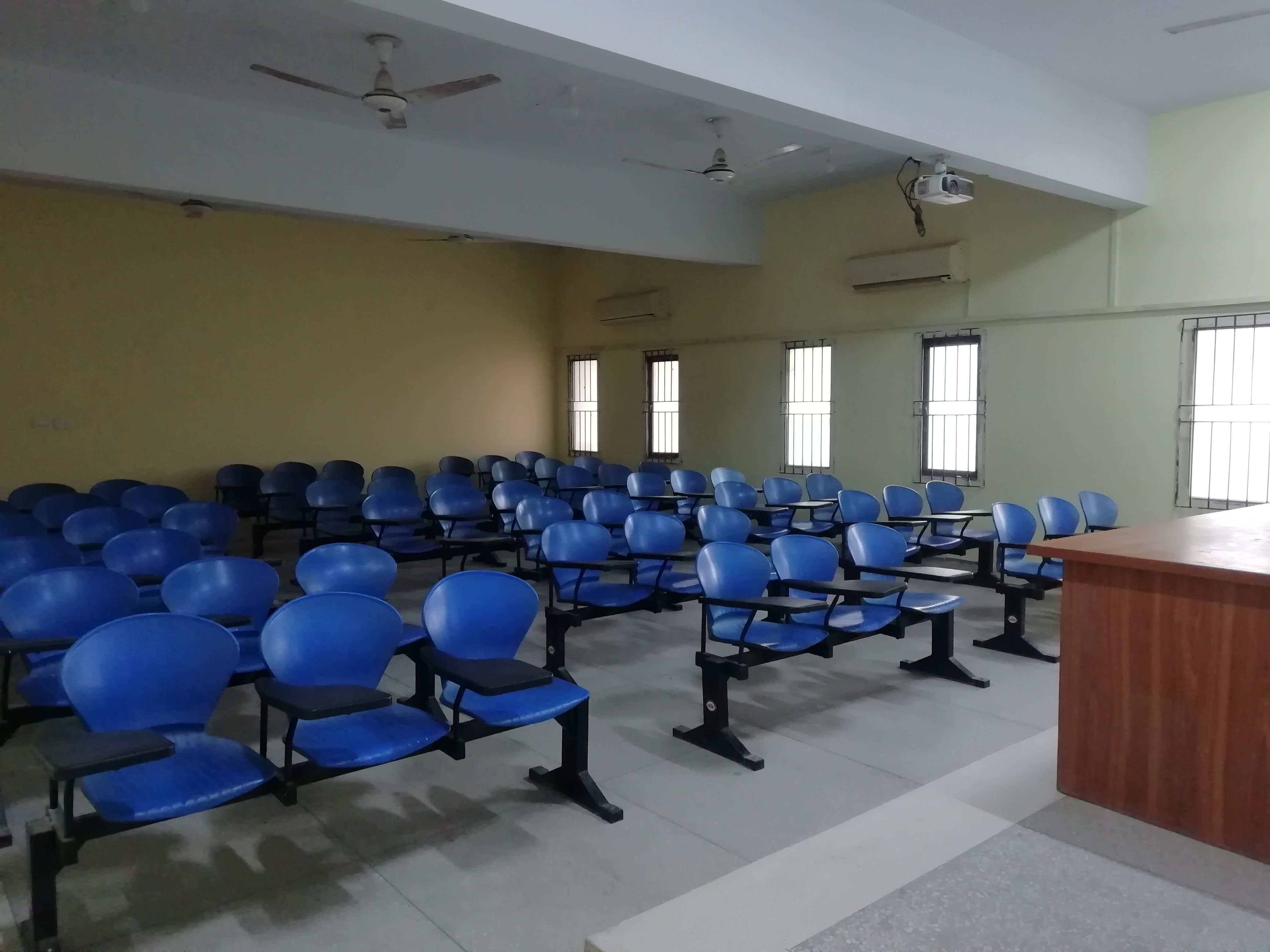
Classrooms:
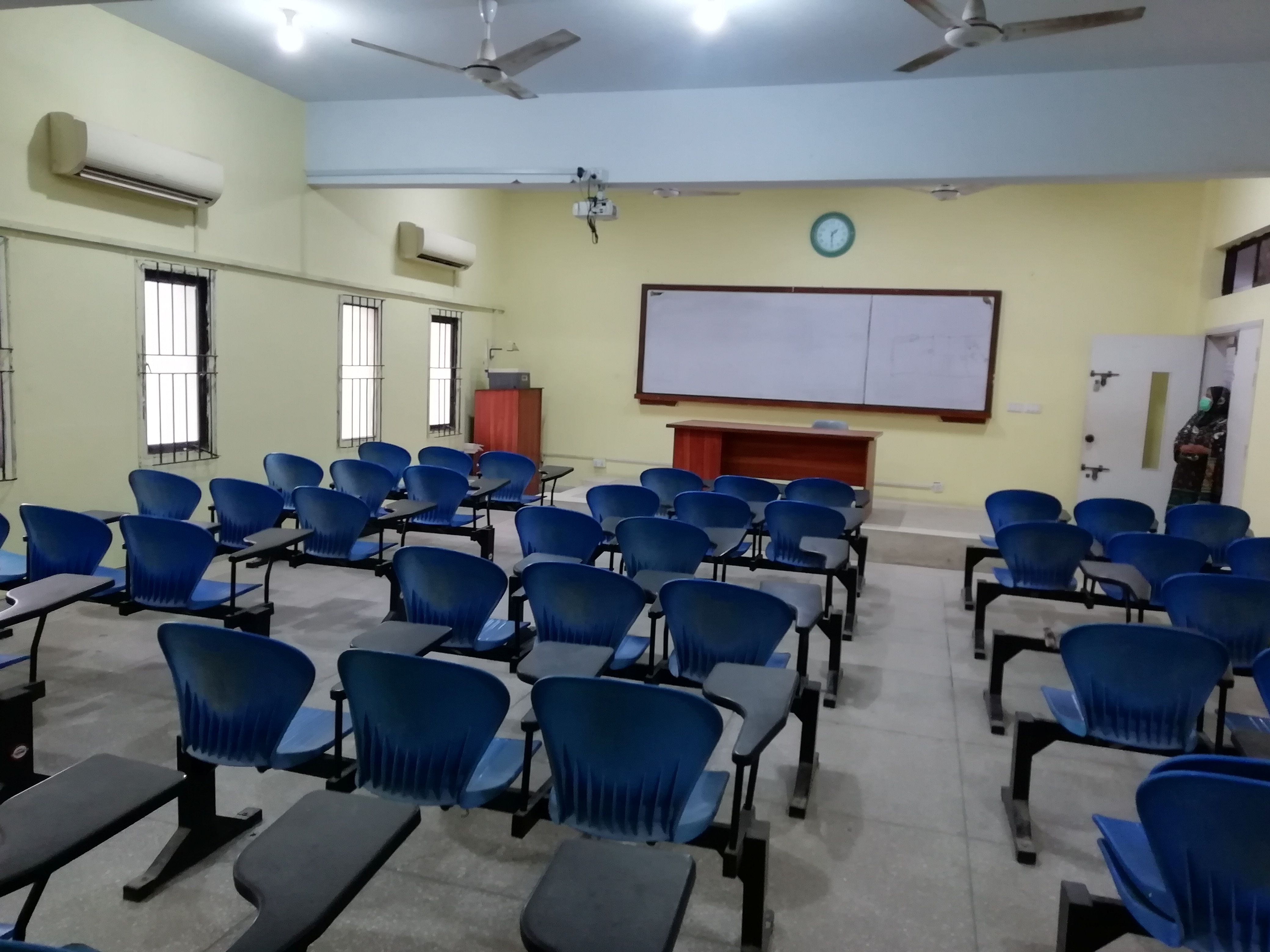
The department owns four classrooms and equipped with multimedia projectors, ensuring a comfortable environment and effective delivery of lectures and presentations.
 |
 |
Teaching Laboratories:
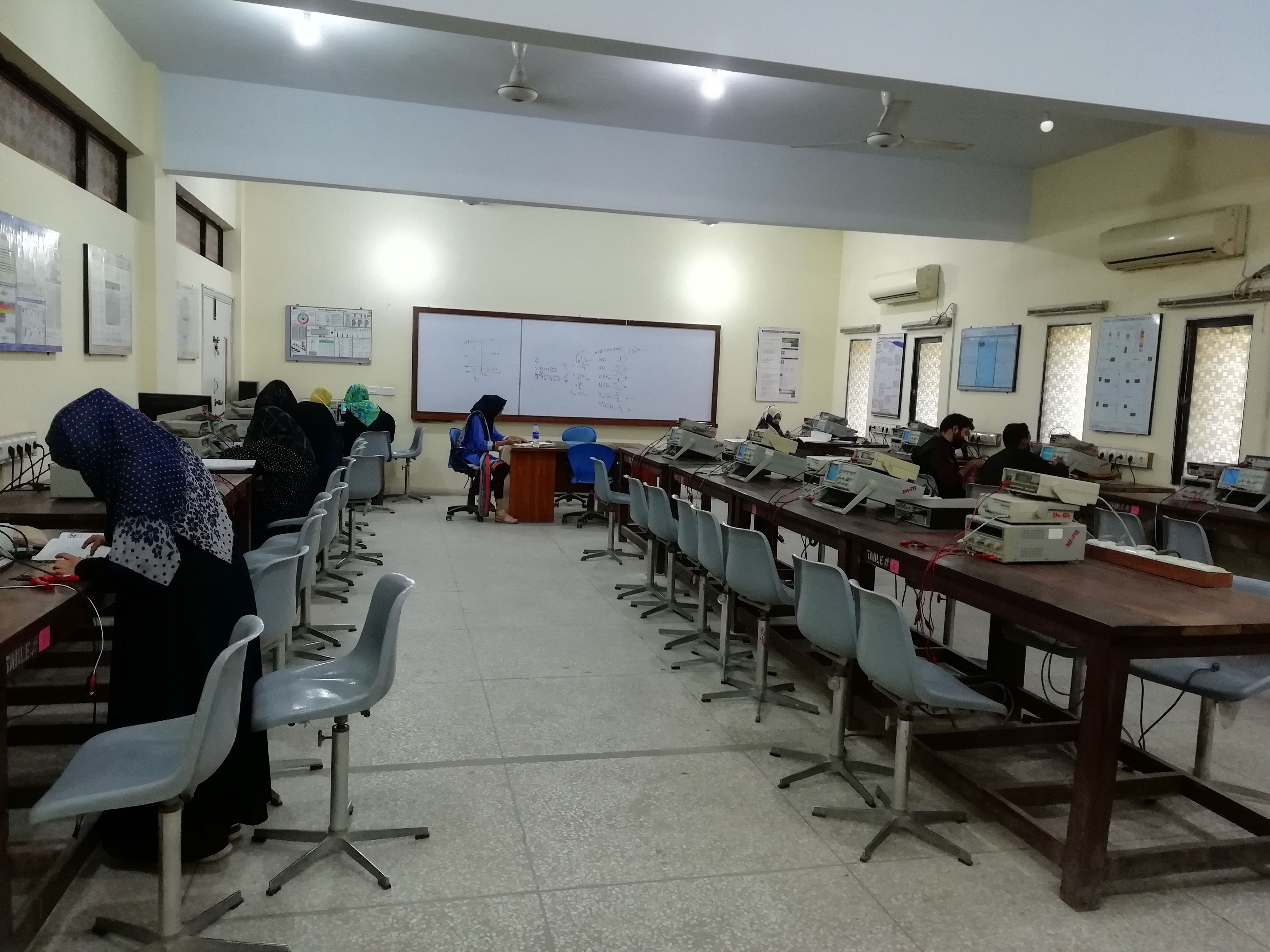
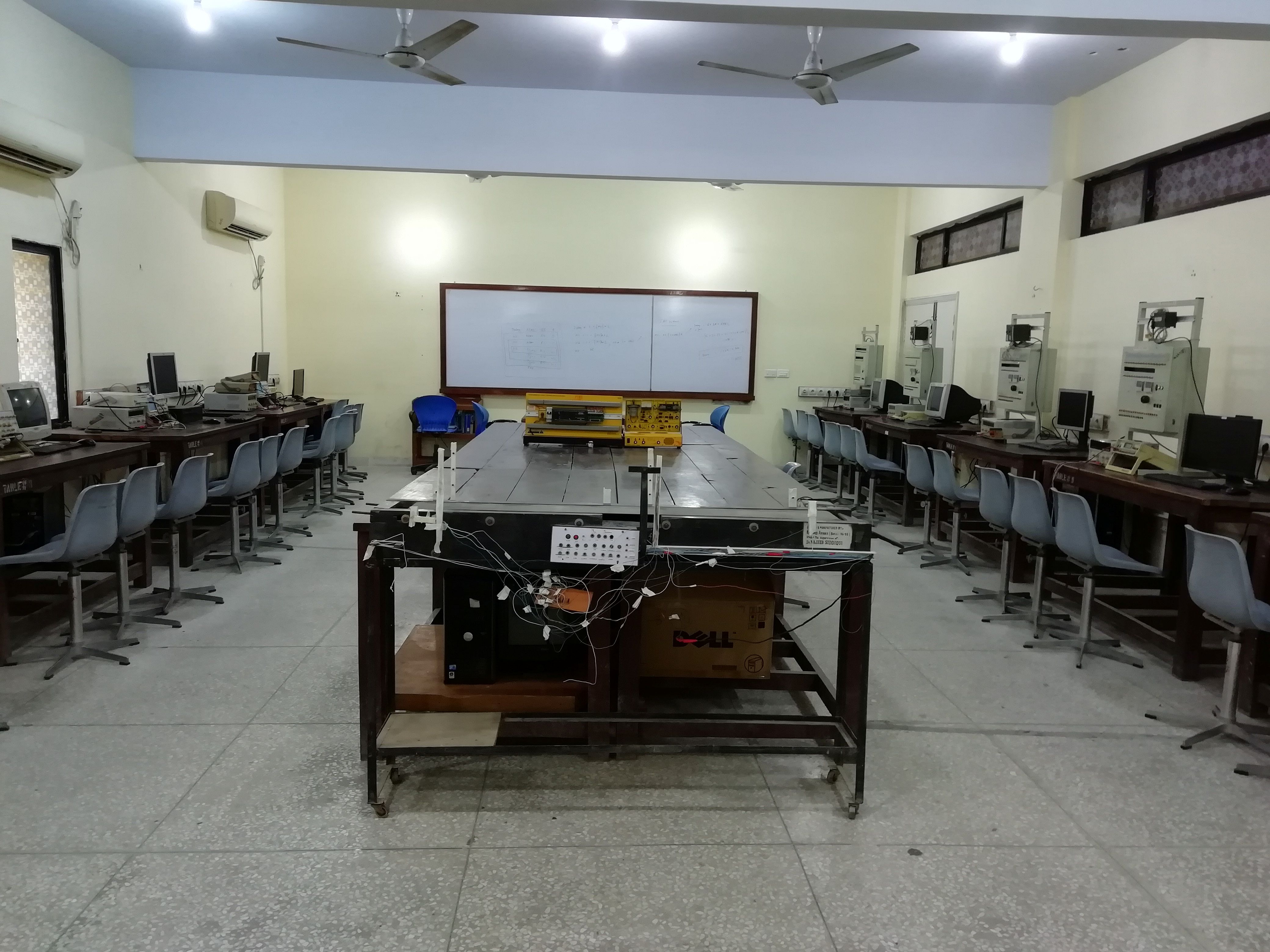
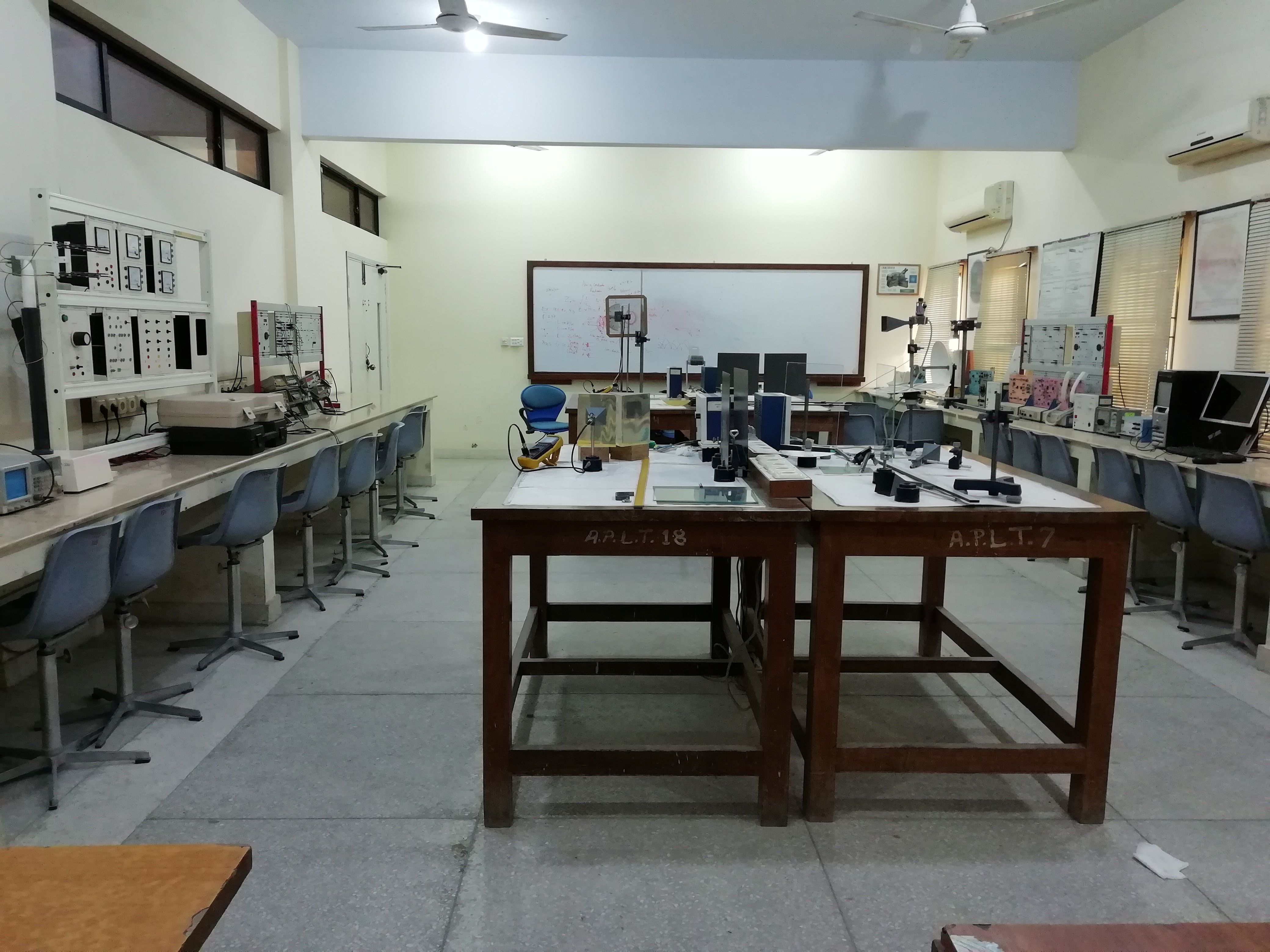
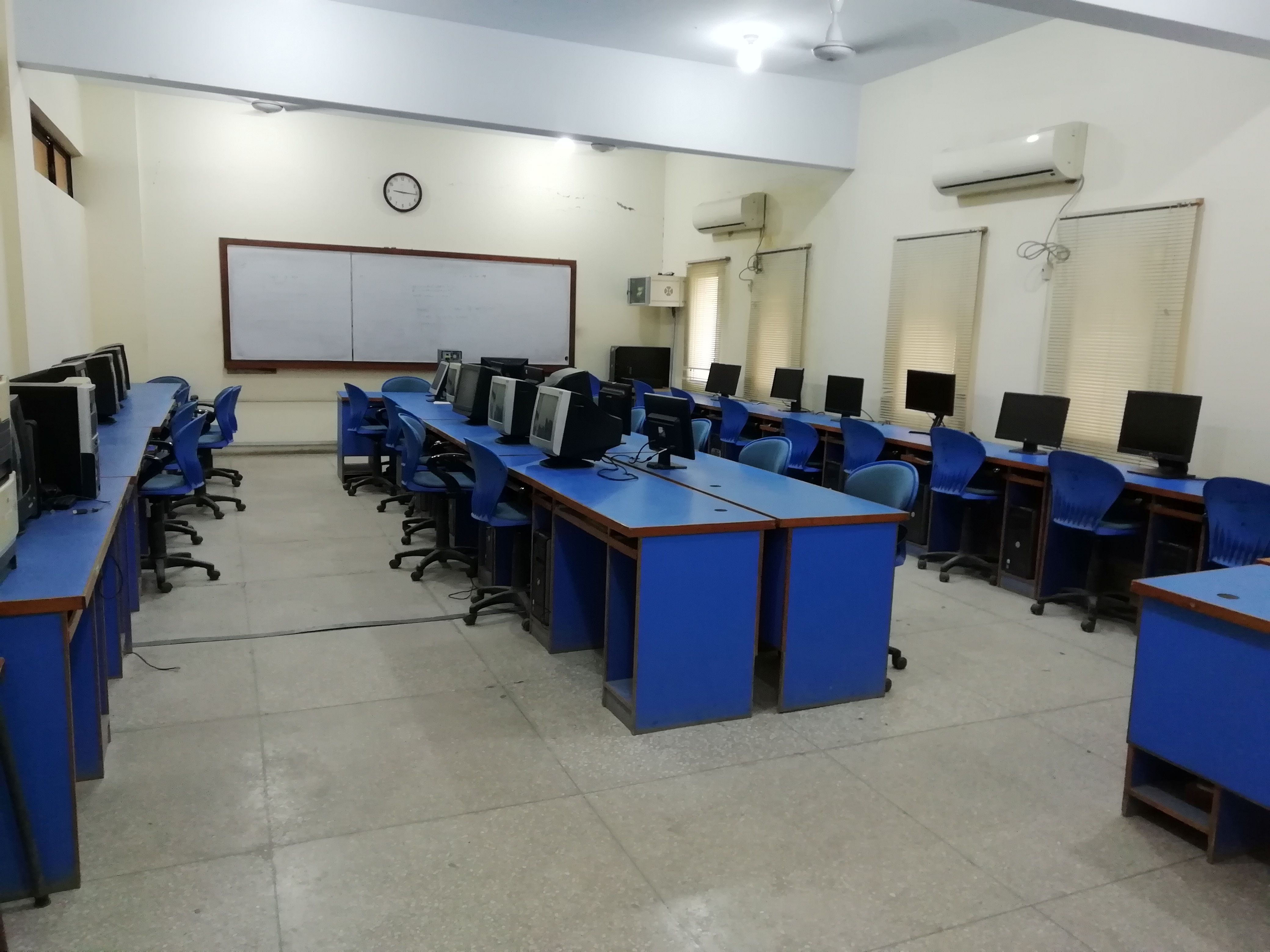
The department maintains spacious and well-equipped laboratories that cater to a broad spectrum of courses. Seven dedicated laboratories are available for hands-on training for subjects like Physics, Basic and Digital Electronics, Industrial Automation & PLC, Digital Signal Processing (DSP), Communication Electronics, Fiber Optics, and Computer Applications. These facilities provide undergraduate students with practical exposure to advanced instrumentation and experimental techniques, thereby reinforcing theoretical knowledge with applied skills.
 |
 |
 |
 |
Seminar Library:
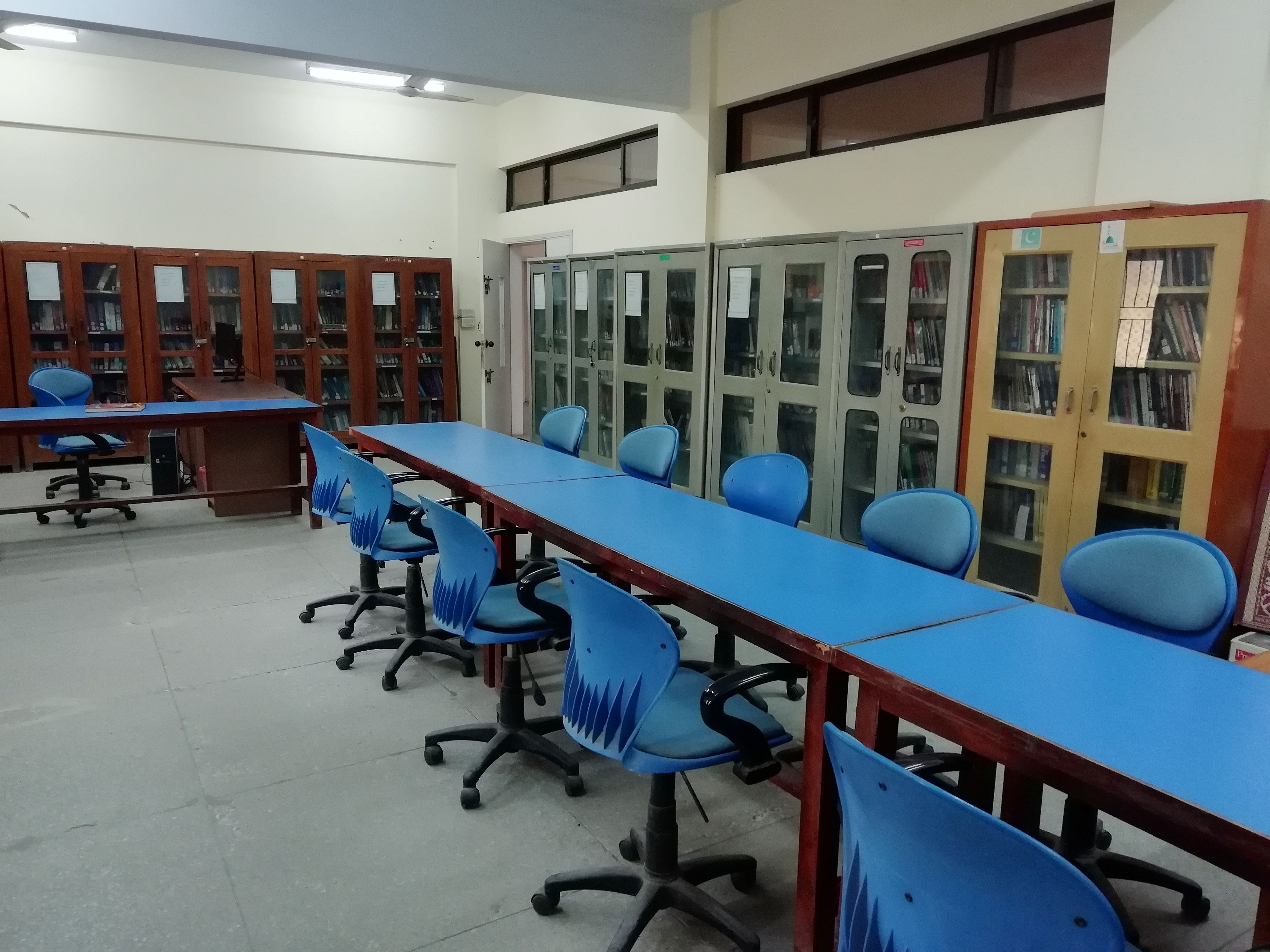
A seminar library, housing a collection of more than 1,500 books and reference materials related to physics, electronics, renewable energy, and advanced technologies, serves as a valuable academic resource for students and researchers.
 |
Girls’ Common Room (GCR):
To facilitate a supportive environment, the department also provides a dedicated Girls’ Common Room, offering female students space for relaxation and interaction beyond academic activities.
Collectively, these facilities foster an enabling academic environment, ensuring that students at undergraduate and graduate levels have access to both the infrastructure and resources necessary for their intellectual and professional development.
Events
Prof. Dr. Azhar Ahmad Ansari Legacy Award for Academic Excellence in Applied Physics
January 31, 2026
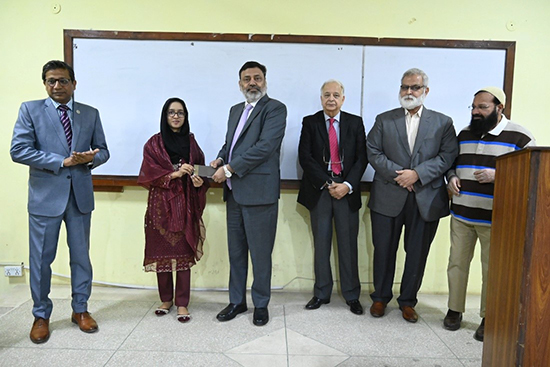
The Department of Applied Physics, University of Karachi proudly organized a special ceremony to mark the launch of the Prof. Dr. Azhar Ahmad Ansari Legacy Award for Academic Excellence in Applied Physics, aimed at recognizing outstanding academic performance among BS Applied Physics students.
The event was chaired by the KU’s Vice Chancellor Prof. Dr. Khalid Mahmood Iraqi and distinguished guests, Faculty Members, Alumni and Students attended the event held at the departmental auditorium today. The ceremony highlighted the department’s commitment to promoting academic excellence and honoring the legacy of eminent educators.
The departmental in-charge Dr. Zeeshan Alam Nayyar informed the audience that Legacy Award has been instituted to acknowledge students who secure top academic positions each year. This includes an Award of Academic Excellence for all the position holders of BS Applied Physics (Morning and Evening Programs) and a cash prize of Rs. 50,000, which will be awarded to the First Position Holder of the BS Applied Physics (Morning Program).
“This prestigious initiative has been generously established by the Applied Physics Alumni of the 1978 and 1979 Cohorts. Their contribution reflects a deep sense of gratitude and commitment to their alma mater.”
Alumni Annual Dinner 2026
January 26, 2026
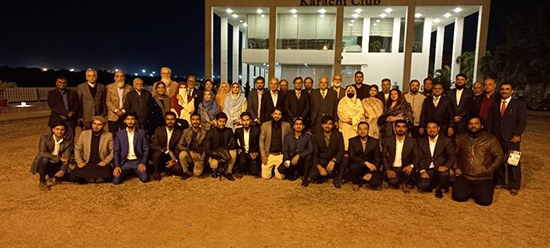
The Department of Applied Physics successfully hosted its Alumni Annual Dinner 2026 on Saturday, January 26, 2026, at the Karachi Club Annexe. The event brought together esteemed alumni, faculty members, and students in an atmosphere of warmth, reflection, and celebration.
The evening provided a valuable opportunity to reconnect, strengthen professional and academic ties, and celebrate the enduring bond between the department and its alumni. It was heartening to witness alumni from different batches coming together to share memories, experiences, and future aspirations for the department.
Field Visit – Master Windfarm Jhimpir
January 21, 2026
On January 21, 2026, a full-day study visit to the Master Wind Energy Ltd. was organized for 4th Year students of Morning & Evening programs as part of experiential & outcome based learning and industry exposure as part of the Renewable Energy course under the supervision of Dr. Zeeshan Alam Nayyar, In-Charge, Department of Applied Physics.
The visit provided students with practical insights into renewable energy generation, wind turbine technology, grid integration, and sustainable power systems, complementing their classroom learning with real-world applications.
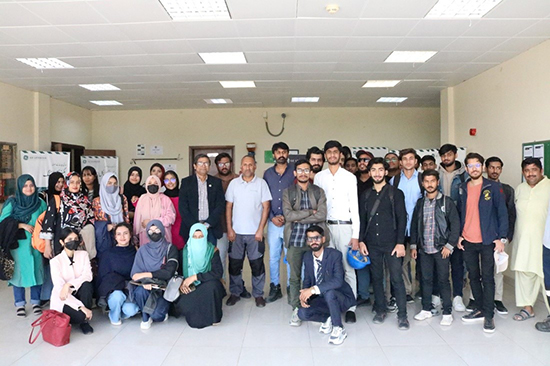
Farewell Party of BS Applied Physics Batch 2022-2025
October 18, 2025
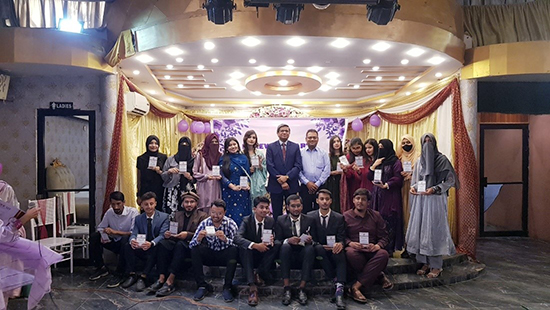
Independence Day Celebrations 2025
August 14, 2025
The Department of Applied Physics proudly celebrated the 78th Independence Day of Pakistan with great enthusiasm and patriotic spirit. The event brought together faculty members, staff, alumni, and students in a vibrant gathering filled with joy, unity, and national pride.
Students showcased their love for the country through heart-touching national songs, thought-provoking skits, and a colorful cultural show representing the diverse traditions of Pakistan. The performances reflected the passion, creativity, and dedication of the youth towards the progress of the homeland.
Resources
Coming soon……
Alumni
Coming soon……
Contact
For Further Enquiry
DEPARTMENT OF APPLIED PHYSICS
UNIVERSITY OF KARACHI, KARACHI-75270
Telephone: 99261300-06 Ext: 2258, 2258
E-mail: aphy@uok.edu.pk
 QR-FaceBook-DAP QR-FaceBook-DAP |
 QR-LinkedIn-DAP QR-LinkedIn-DAP |
Apply to the Department of Applied Physics
Explore programs and pathways through the University's admissions process.

